This Old Magic: Disenchantment and the New Skate Urbanism
Brian Glenney on the risks of sanctioned skate spaces.

Associate Professor of Philosophy at Norwich University, Vermont, USA.
Skate Urbanism describes a strategy for producing skatable spaces wherein skaters collaborate with city officials to design them and plan their integration into urban architecture. In this paper, I argue that Skate Urbanism gradually undermines the creative capacities and street practices that produce skateboarding’s distinctive value to urban life. These creative capacities include the skills and values produced from skateboarding’s bottom-up "insurgent" processes and use of unsanctioned spots. Specifically, sanctioning skate spaces and using political processes desensitizes street skateboarding’s programming of the “skater’s eye” used to find and appropriate spots, along with the skills to skate and maintain them. Skate Urbanism also risks weakening skateboarding’s foundational cultural values of independence, freedom, agency, and resistance to institutional control.
The fucking city is run by pigs.
Taking the rights away from all the kids.
Understanding we are fighting a war we can’t win.
They hate us, we hate them. We can’t win no way.
-Black Flag, “Police Story”
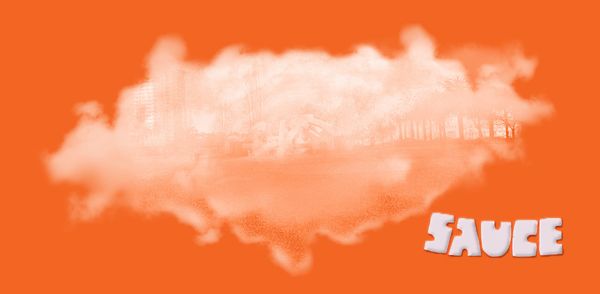
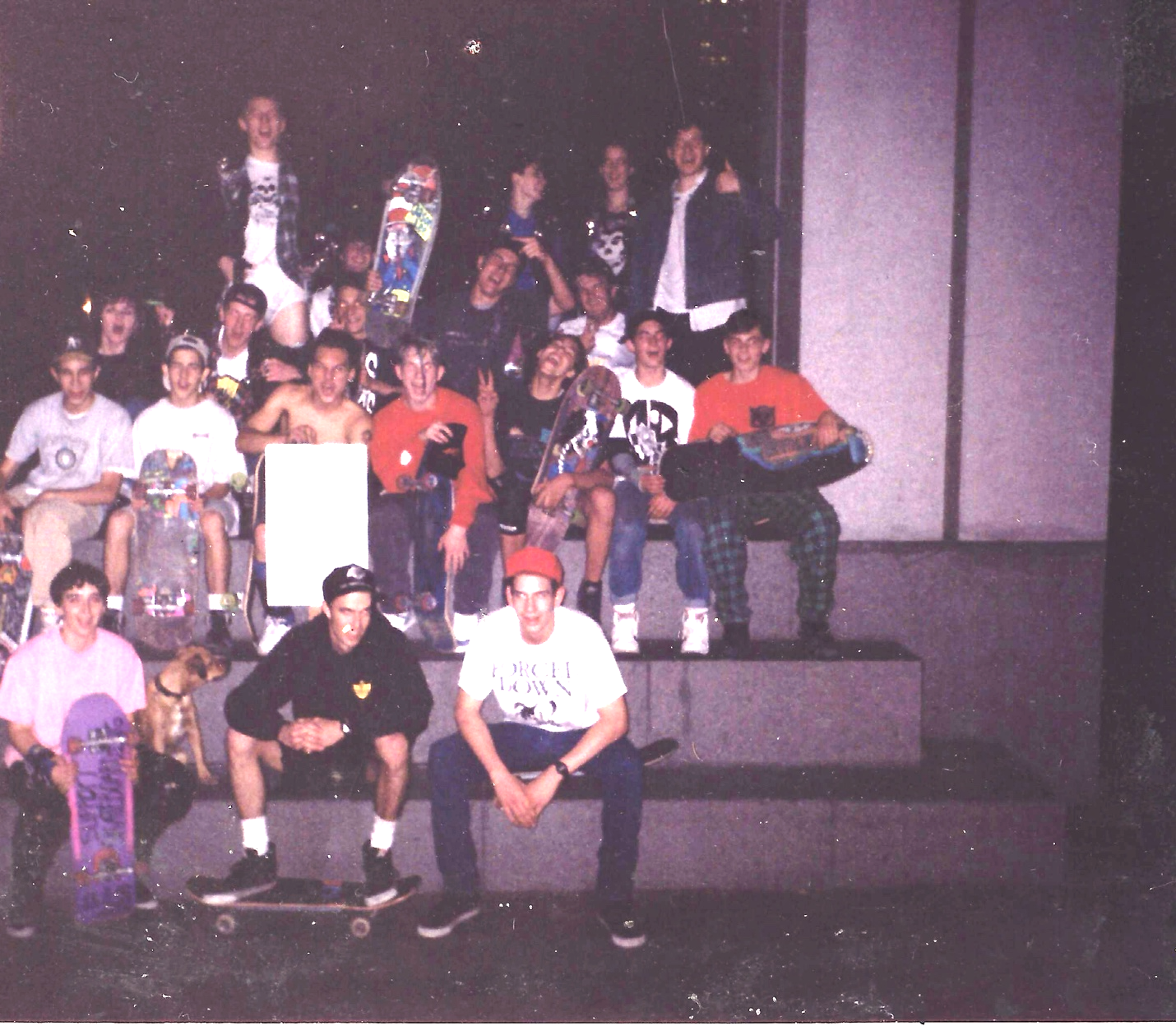
In Spring 2026, Seattle’s Westlake Plaza became a sanctioned skate space and included a new granite ledge and manny pad built for the purpose of skating. Prior to this change, skaters had illegally appropriated Westlake’s rose and gray granite tile surface and granite ledges into a spot for Northwest US street skateboarding since the late 1980’s (see Image 1). This reappropriation included dodging security and gangs throughout the 1990s, vandalizing obstructing planters, and removing skate stoppers as the city clamped down, prompting tales known now as Westlake stories. Similar war stories or tales of how individuals handled street-based hardships as “rites of passage” (Roche et al., 2005) are a part of every local scene across the globe, even as their spots change in meaning through legalization and are remodeled with purpose-built obstacles designed for skating.
In this paper, I take up the question on the minds of many skaters and skate scholars: what effect will the legalization of spots and purpose-built obstacles have on skateboarding’s cultural practices and meaning (Book, 2024, Kilberth, 2025)? Did the skaters “win” their Black Flag-esque war with the city by being granted the right to skate? Will legalized skate spaces and purpose-built obstacles disenchant the “old magic” of these spots? Might a new magic with new urges and desires from a more diverse group of skaters emerge? Is skate culture undergoing a paradigm shift? (Lundry, 2002)
These questions are particularly pertinent today. In 2024, a part of Philadelphia’s LOVE Park was rebuilt in Malmö, Sweden, for the purpose of skateboarding; an effort Karin Book (2024) calls “value co-creation.” San Francisco’s UN Plaza was redesigned in 2023 as a sanctioned skate space, perhaps to alleviate the blowback as the more famous Embarcadero Plaza faces imminent destruction, just as China Banks has recently been destroyed, a fate similar to the Hubba Hideout. (For more discussion of these shifts in San Francisco’s skate space, see Harrison-Caldwell, 2026). Hybrid copies of these spots, called “hubbas” and “China banks,” are architectural designs found in skateparks throughout the world, and lack the same value and cultural meaning as the original (Glenney & O’Connor, 2019). Do we want a future of de-cultured copies of a destroyed MACBA plaza? Are Burnside and London’s Southbank reduced to de-cultured copies with their new legalized heritage status?
Some Terminology
By using the word magic, I just mean whatever makes for the cultural meaning of skateboarding that urges its activity and grounds its creativity. This includes all kinds of aspects, including the “old magic” unexplainable meaning and urge to skate an unsanctioned spot, a description at least partially captured by Lefebvre’s discussion of certain areas of the city. “Our space has strange effects. For one thing, it unleashes desire” (Lefebvre, 1974). After this passage, Lefebvre is confronted with the dilemma of “empty spaces,” areas lacking clear affordance for use despite prompting desire. These empty spaces are not only resolved by the skateboarder’s appropriating imagination and board but are necessary for the specific kind of creative values of skate culture that are part of this magic. If a skater sees a spot with their “skater’s eye,” a capability discussed more below that affords their unique trick play and satisfies their urge to skate, then the result is an increased authenticity and agency (Buckareff & Glenney, 2026).
It is in this context of Lefebvre’s “empty spaces” where we might mint the meaning of the legalization of skate spaces produced by “Skate Urbanism” (Owens, 2014). I define “skate urbanism” by its ability to find a different resolution for Lefebvre’s empty spaces, replacing traditional DIY appropriation with “design” imagination and city collaboration. Skate Urbanism uses a designed and planned tactic for producing “skate friendly” cities, exemplified by Malmö and Bordeaux. The phrase “skate urbanism” should follow past uses of the term “urbanism,” which describe how cities might be friendly to “everyday human life,” but fails to do so, as the theory of urbanism lets users decide though DIY uses of public space. By contrast, the design practices of “skate urbanism” are formal and “top-down” in their approach to creating public space, borrowing more from the 1920s urban planning view known as “New Urbanism” (Crawford, 1999), where the city plans and designs spaces for their own version of a human-friendly city. Thus, in this paper, I use the more descriptive phrase New Skate Urbanism to describe these new tactics for “skate friendly” cities, which include decoding what makes a good skate spot and designing and installing sanctioned skate spaces specific for skateboarding, among other things.
A General Argument against New Skate Urbanism
This rephrasing of skate urbanism into “new skate urbanism” is a part of my critique of planning and designing of skate friendly cities. I argue that new skate urbanism is unfriendly to skateboarding and its “old magic.” Note that this critique is not to demean the amazing work of these New Skate Urbanists, whose creations I admire and skate with eagerness and fun. Rather, this critique is aimed at the underlying concepts of the New Skate Urbanism and its potential detriment to skating’s reappropriation of “magical” spots and their diverse creative uses and meanings. The old magic creativity grounds the real meaning of spots that cannot be decoded and is a part of what makes skateboarding so mysterious and unique (Glenney & Mull, 2018). Skateboarding risks losing its creative cultural meaning when sanctioned, or when purpose-built objects are installed there for skating.
To establish this point, the spot a skater skates reflects their aesthetic and style, revealing a unique identity and authenticity. This helps account for why many skaters do not film their parts at a skatepark as these spaces diminish the individuality of their style. Similarly, locals of “skate friendly” cities like Copenhagen and Malmö’s Poetic Collective often avoid filming at purpose-built skate spaces, finding them to be ill-fitting for their aesthetic, which is informed by reappropriation of skate spots. For instance, cobblestone is a favored surface for their media even though cobblestone is virtually unskateable due to its deep grooves, and is even commonly used as a “skate stopper” (Howell 2001). This seemingly junk bricolage, or “crap to skate” (Borden 2001), serves as a kind of proof of concept to the reappropriation of urban space, yielding an unmistakable authenticity to a skater’s trick. Non-local skaters may cry out, "How can they skate that!?" a proper response to the local’s old magic trick proving the impossible.
This point follows Glenney and Mull (2018), who argue for the preservation of an aesthetic and ethical authenticity based on “ecocentric” engagements with skateboarding’s “natural” spots. Just as the mountain climber’s excellence should be judged by how well they take up the perspective of the wildness of the mountain, meeting nature on its own terms as best they can, so too should the skater in the streets. If climbers use hammering spikes to hold their rope, their activity is overly mediated by human technology compared to using removable wedges in a mountain’s cracks, as the climber must “relate the range of his technology to the structure” of the rock they are climbing (Dougherty, 2007). Skating a sanctioned space is like skiing at resorts, fishing in stocked lakes, hunting on private animal reserves, all examples “in which engagement with Nature is overly mediated” (Dougherty 2007). The more that nature is engaged on its own terms, the more authentic and ethical are its imaginatively creative uses of the body.
The “magic” of a spot, or whatever it is that makes skate spots invoke an urgency to skate them and the cultural meaning that is produced, is grounded on the creative counterpolitics and reappropriation needed to skate “natural” street features not made for skateboarding. This view is shared by McDuie-Ra (2025), whose concept of a skater’s “insurgent play” includes the “wild” urban ecology of the street, like errant pedestrians, protective security, and often unstable surfaces. It follows early descriptions of skating as feral or “sauvage” (Caroux 1978) and demands the development of various skills and sensory attunements to make illegal spots viable for skating. The feral skaters’ street ecology also fortifies the tight-knit community that variously supports the ability to skate a spot by watching out for security and cars, de-knobbing spots and repairing surfaces, filming and photographing their use, and celebrating successes.
The sanctioning of previously wild skate spots is seductive. Preserving Westlake, or resurrecting LOVE park in a skate-friendly city (Book, 2024), or even advocating for skating at the LA Courthouse or Brooklyn Banks (Chiu & Giamarino, 2019) seems to have its own kind of magic, a “new magic.” But these tactics change the cultural meaning of these spots, producing a simulation or a simulacra (Baudrillard, 1994), a “new” Disneyland-like magical kingdom where fun comes pre-made.
Maybe it is better to let old spots die and put energy into new skate spots. This would continue skateboarding’s counterpolitical processes of reappropriation and produce a real skate-friendly city where the existing infrastructure includes a diverse and large quantity of illegal spots ripe for appropriation and a diversity and large quantity of skaters with distinctive ways of skating these spots.
A Specific Argument: The New Skate Urbanism creates “Ecological Traps”
On this old magic view, new sanctioned skate spaces, like Seattle’s Westlake Plaza and its new skatepark-like ledge and manny pad, are like a Trojan horse, a “poisoned gift,” a cadeau empoisoné. Sanctioning a space disenchants the spot’s magic and designing obstacles de-programs the skater’s eye and deskills a skater’s city craft for maintaining them, as discussed by Hölsgens & Glenney (2024; see also Glenney & Hölsgens 2026). The result is a skate space that is comparatively sterile and homogeneous, de-styling aesthetics into athletics, lessening the urge to skate the spot creatively—much less film and photograph attempts to do so. How many more back tail slides on a purpose-built knee-high ledge made for skateboarding do we really need to watch? Sanctioning skate spaces diminishes and degrades the processes that give skaters control over their own means of production of spots, a control that grounds skateboarding’s real value to the city.
This critique follows Mould’s (2015) argument that the planning and designing of everyday human life by New Urbanisms and their sanctioned “creative” city “eats itself,” stunting the innovation and decreasing the very diversity it is attempting to attract. Counterpolitical processes and reappropriating spots are the basis of the very creativity that makes skateboarding uniquely activating for a city and its spots uniquely desirable to skate. Mould advocates for the unsanctioned creative city of Urbanism (Crawford, 1999) to produce real creative value through its striated folds in a Mandelbrot Set of diverse meanings, unleashing a kind of cultural meaning that cannot be controlled, casting spells of the old urban magic that unleashes desire, urgency of use, and seemingly infinite one more try forms of resilience.
The underlying significance of the New Skate Urbanism and its sanctioned skate spaces is analogous to what nature conservationists call “ecological traps”: habitats preferred by animals in spite of diminishing their fitness for survival (Battin, 2004). Bird feeders and landfills attract huge numbers of insects, birds, and mammals, but their continual use desensitizes and deskills natural survival capacities, producing generational deficits that lead to extinction. Sanctioned skate spaces are similarly desensitizing and deskilling as they promote passive consumption due to their ease of use. Notice, for instance, how new consumption-based debates have emerged about whether a purpose-built ledge or rail is too high, a complaint that finds legitimacy only in the New Skate Urbanism, but falls flat in the streets where rail and ledge sizes are produced by individual skaters, self-selected by their appropriation and illegal use. Just as skateparks share a significance similar to bird cages, purpose-built obstacles in sanctioned skate spots are like bird feeders. By contrast, the skater’s natural ecology of unsanctioned skate spots has the significance of a bird’s natural ecology of wildflowers and old-growth forests as pollinators and pioneer species.
A Specific Harm: Cognitive Offloading from Sanctioning Skate Spaces
To strengthen this argument, consider a specific trait of skaters in their natural street ecology: “the skater’s eye” (Buckareff & Glenney, 2026). As mentioned above, this sensory ability gives skaters the capability to locate spots in the city that afford trick play along with the motivation to skate them. The skater’s eye requires significant street practice to obtain and maintain. This is because the skater’s eye is a kind of “cognitive gadget” (Heyes, 2018), similar to modern capacities like reading or more primitive-based capacities like foraging for wild mushrooms, requiring emplaced exposure, learning experiences, and continued practice to recognize specific patterns in a distracting “noisy” environment. The skater’s eye is a trait often programmed by years of on-site use and recursive feedback, imaginative thinking, and from various instructional media like skate photos and films (Buckareff & Glenney, 2026).
Once obtained, the skater’s eye can be further fine-tuned to appropriate spots specific to performing a unique trick that fits the unique style of the skater, promoting a kind of authenticity and personal style or “flow” that provides personal fulfilment and enchanting joy (Seifert & Hedderson, 2010), distinguishing a skater’s identity from their peers. Some skaters’ sensory abilities become so enhanced they unconsciously feel a spot that fits them prior to consciously cognizing its location. “There are some places that smell like skate spots” (Kazi-Tani n.d., 5). Finding and skating a spot is thus similar to the insightful challenge of reading a difficult book like Infinite Jest or the joyful surprise of finding a hidden edible wild mushroom like a matsutake. The greater the challenges faced by a skater in the streets, the more honed their senses, the greater their sense of agency and self-realization, the more creative and authentic their sense of meaning and fulfilment for themselves and the culture. This qualitative meaning is why skateboarding’s old magic cannot cast its spells of meaning for athletic performance alone. The old magic enchants within the aesthetics of ethically-sourced spots chosen for uniquely identified street performances and the creative appropriation that individualizes specific personal expression and identity.
This is not to say that acquiring cognitive gadgets like reading, foraging, and finding skate spots are easy. No, these are tasks requiring massively focused cognitive loading and countless hours of practice. This really makes reading, foraging, and finding spots seem inaccessible for people whose lives lack leisure time or for whom the city (or school or forest) is a hostile place. For the demands of spot finding are risky and inefficient, consuming vast amounts of energy and time, truly a life-long pursuit. In some participants, the inefficiency of these demands motivates various “cheats”: tools and processes that alleviate this inefficiency and offload cognitive demands.
These cheats are what motivate the New Skate Urbanism and its designing of purpose-built spots to look like street spots. This is like farming wild species of mushrooms such as Oyster, Shiitake, and Lion’s Mane by simulating their natural diet with coffee grounds, sawdust, and straw, though sterilizing their flavor. So too, Large Language Models (LLMs) can ease the difficulty of reading by creating summaries and other passive reading tools. These passive tools decrease active cognitive engagement, diminishing reading skills, a deficit known as “cognitive debt” (Armitage, 2025). LLM use for reading is likened to “fast fashion for the mind,” that “replace authentic, original thinking with averaged out beige, boring platitudes,” a kind of “ersatz thinking” (Lévesque, 2026). Insofar as New Skate Urbanism’s sanctioned skate spaces are analogous to farming wild mushrooms and cognitive offloading reading by using LLMs, they detune skateboarding’s street senses and deskill its capacity for counterpolitical processes, de-authenticating skateboarding’s cultural meaning by de-aestheticizing its spots of creativity.
Conclusion
Kilberth (2025) advocates for the New Skate Urbanism’s tactic of sanctioning skate spaces by arguing that its significance is less about the underlying theoretical concepts that are the focus of this paper’s critique, or even their fun use. The New Skate Urbanism is rather a natural evolution due to two cultural shifts: 1) cities, particularly in Europe, now recognize the need to support creative cultures to compete in the global market and 2) creative cultures like skateboarding, now recognized for their centrality to city life, are maturing and able to reciprocate political negotiation with cities. “Boundary spanners” (Lacam & Evon, 2025), civically minded skateboarding leaders like Léo Valls in Bordeaux and Gustav Eden in Malmö, help mitigate prior stigmas on both sides, co-creating value for skate-friendly cities. These cities are, in fact, very fun to skate, including their sanctioned skate spaces, and the work of everyone involved is impressive and powerful.
Co-created sanctioned skate spaces are also being adopted by skateboarding’s more “core” media. Kyron McGrath-Davis graces the cover of a recent Free Skateboard Magazine (Issue 66, 2026) with a frontside air gapping two banked monoliths designed and built as a “shared space” for skating in London. This is a shift in skate media away from photos of skateboarders performing tricks in often gritty “illegal skate spots,” photos that are part of the past training of the skater’s eye (D'Orazio, 2020). The popularity of sanctioned spaces has led to “opportunities of spatial concepts that ‘reintegrate’ skateboarding back into the public realm as structurally more integrated and inclusive spaces in the city” (Kilberth, 2025). Kilberth’s point leads us back to our introductory questions about the meaning of sanctioned skate spaces.
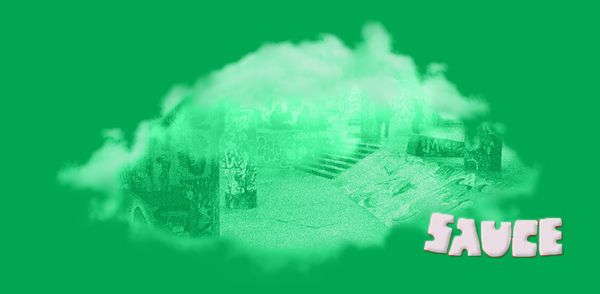
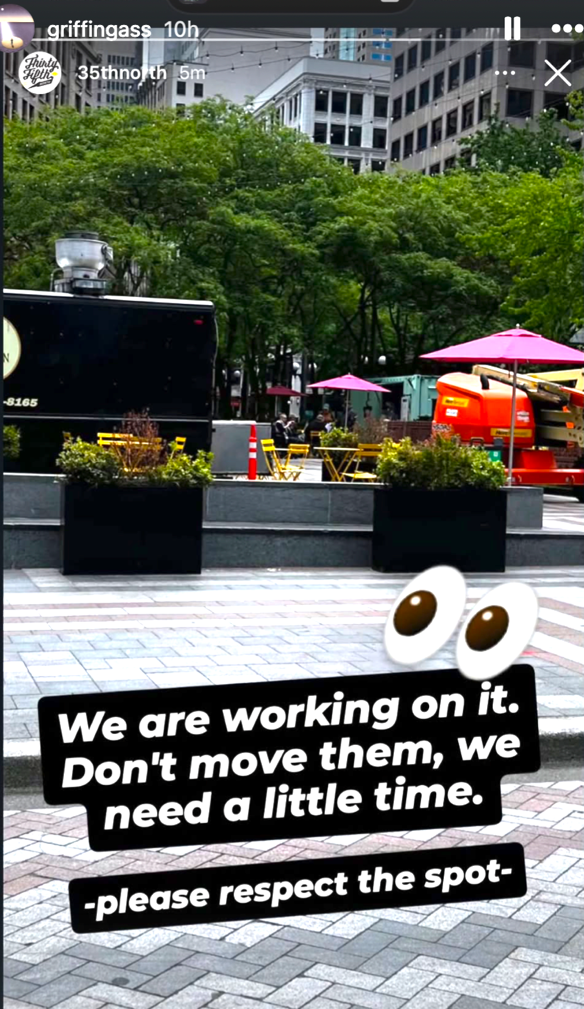
Consider again the now-sanctioned Westlake Plaza and its purpose-built granite ledge and manny pad addition. This addition came with another feature: large planters around the new granite block as well as table and chairs placed on the manny pad, a kind of hostile architecture that aims to reassert control over the sanctioned skate space. Furthermore, this is a compromise that the New Skate Urbanism appears willing to accept, a consequence of their new magic. (See Image 2.)
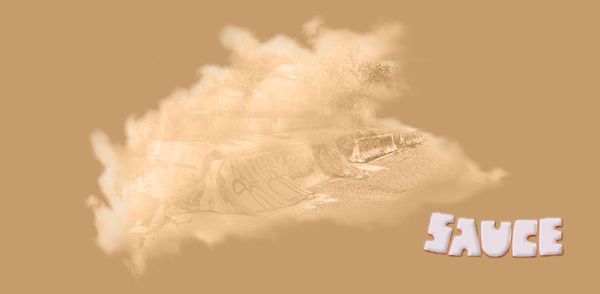
However, from the perspective of the old magic, this hostile architecture is host to numerous opportunities for reappropriation. Skaters with tuned senses and street enskilled capacities will think of ways to incorporate the planters into the skating of the granite block, treating the planters as objects for trick play rather than obstructions. (See Image 3) This expresses the kind of old magic reappropriating creativity that the counterpolitical processes of skaters cognitively upload when using their skater’s eye, one that is at risk if their only sources for skating are sanctioned spaces.
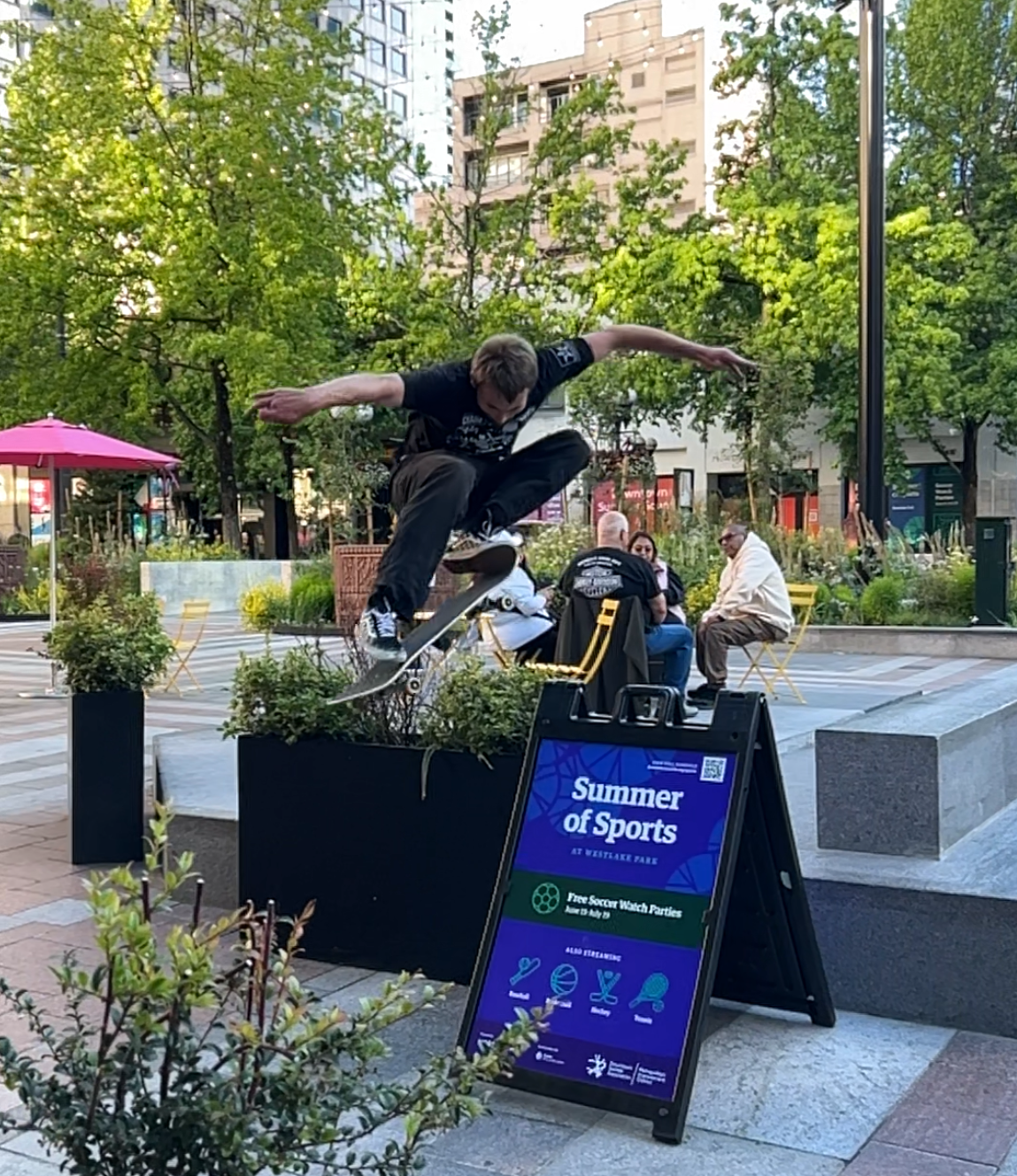
I want to suggest that the old magic of Westlake, preserved in the oral tradition of Westlake stories, as well as photos and videos, and in the cultural gadget of the skateboard itself, is too powerful to be disenchanted by a few purpose-built blocks or a new sanctioning magic and its acceptance of hostile architecture. Skateboarding’s counterpolitical spells can re-enchant even sanctioned spaces to become natural, ethically sourced spots again. And with each new planter variation set out by the city to obstruct, the skate spot is reborn with new opportunities for magical interpretation. In other words, Westlake’s new planters will themselves become obstacles for grinding and sliding, likely breaking and requiring a response from the city in the form of better built or knobbed planters, or some similar hostile architecture that transfers the space into a spot where the spells of the old magic can be recast and skating there requires counterpolitical processes again.
The old magic that enchants the skated city will not die easy, and will outlive the new magic of New Skate Urbanism and its skate-friendly cities. As Lundry (2002) argues, there are no paradigm shifts in skateboarding. Even sanctioned skate spaces like Westlake, particularly with its planter obstacles, reproduce the ecological conditions for reappropriation that have entrained and enskilled “feral” skaters for generations so that skateboarding can continue its crucial ecological role of insurgent play in the city, a role that cannot be directly replicated in simulacra sanctioned skate spaces but can be produced indirectly through an insurgent use of them.
Author
Sources
Battin, J. (2004). When good animals love bad habitats: ecological traps and the conservation of animal populations. Conservation Biology, 18(6): 1482-1491. https://doi.org/10.1111/j.1523-1739.2004.00417.x
Baudrillard, J. (1994). Simulacra and simulation. University of Michigan Press. https://doi.org/10.3998/mpub.9904
Book K (2024). No need to be rebellious: placemaking and value co-creation in the skateboarding City of Malmö. Front. Sports Act. Living 6:1455642. https://doi.org/10.3389/fspor.2024.1455642
Borden I. (2001). Skateboarding, Space and the City: Architecture and the Body. Oxford: Berg Publishers.
Buckareff, A., & Glenney, B. (2026). The role of risk in programming the skater’s eye. Journal of the Philosophy of Sport, 1-16. https://doi.org/10.1080/00948705.2026.2643342
Caroux, J. (1978). Figures urbaines du quotidien : le skate sauvage. Esprit 22 (10): 33–35.
Chiu, C., & Giamarino, C. (2019). Creativity, conviviality, and civil society neoliberalising public space: Changing politics and discourses in skateboarder activism from New York City to Los Angeles. Journal of Sport and Social Issues, 43(6), 462–492. https://doi.org/10.1177/0193723519842219
Crawford, M. (1999). Introduction. In J. Chase, M., Crawford, & J. Kaliski (Eds.), Everyday urbanism. New York: The Monacelli Press.
D'Orazio, Dax. (2020). The skate video revolution: How promotional film changed skateboarding subculture. The International Journal of Sport and Society 11, no. 3 (2020): 55. https://doi.org/10.18848/2152-7857/CGP/v11i03/55-72
Dougherty, A. P. (2007). Aesthetic and ethical issues concerning sport in wilder places. In McNamee, M Philosophy, risk and adventure sports (pp. 108-119). New York City: Routledge.
Glenney, B., & Hölsgens, S. (2026). Of skills and tools: Skateboarding as city craft. International Review for the Sociology of Sport, 61(4), 928-944. https://doi.org/10.1177/10126902251360438
Glenney, B., & O’Connor, P. (2019). Skateparks as hybrid elements of the city. Journal of Urban Design, 24(6), 840-855. https://doi.org/10.1080/13574809.2019.1568189
Glenney, B., & Mull, S. (2018). Skateboarding and the ecology of urban space. Journal of Sport and Social Issues, 42(6), 437-453. https://doi.org/10.1177/0193723518800525
Guignon, C. (2004). On Being Authentic. London: Routledge. https://doi.org/10.4324/9780203646793
Harrison-Caldwell, M. (2026). San Francisco: The City Where Skateboarders Won? San Francisco Standard. 13, July.
Heyes, Cecilia. Cognitive gadgets: The cultural evolution of thinking. Harvard University Press, 2018. https://doi.org/10.2307/j.ctv24trbqx
Hölsgens, S., & Glenney, B. (2024). Skateboarding and the senses: Skills, surfaces, and spaces. Routledge. https://doi.org/10.4324/9781003510642
Howell, O. (2008). Skatepark as Neoliberal Playground. Urban Governance, Recreation Space, and the Cultivation of Personal Responsibility. Space and Culture, 11(4), 475–496. https://doi.org/10.1177/1206331208320488
Howell, O. (2001). The poetics of security: Skateboarding, urban design, and the new public space. Urban Action, 30, 64-86.
Kazi-Tani, T. (n.d.) (Un)Desired Spaces: DIY Skate Spots as Critical Participatory Urban Design. https://www.academia.edu/33019125/_UN_DESIRED_SPACES_DIY_SKATE_SPOTS_AS_CRITICAL_PARTICIPATORY_URBAN_DESIGN
Kilberth V (2025). Spaces for skateboarding in the city–new spatial concepts beyond skateparks. Front. Sports Act. Living 6:1457427. doi: 10.3389/fspor.2024.1457427. https://doi.org/10.3389/fspor.2024.1457427
Lacam, J. S., & Evon, J. (2025). The Role of the Boundary Spanner in Territorial Public Management: The case of Bordeaux street skateboarding (skaturbanism). Available at SSRN 5677122. https://dx.doi.org/10.2139/ssrn.5677122
Lefebvre, H. (1974/1991). The production of space. Oxford: Blackwell.
Lévesque, Maroussia. "A Mind of One's Own." Forthcoming in Philosophical Foundations and Practical Implications of Digital Humanism (eds. Julian Nida-Rümelin & Nathalie Weidenfeld), Springer (2026).
Lundry W (2002). Subvert the dominant paradigm. Thrasher Magazine, 1 October.
McDuie-Ra, D. (2025). Insurgent Play: Social Worlds of Urban Disruption (Vol. 1). Anthem Press.
Mould, O. (2015). Urban Subversion and the Creative City. London, New York: Routledge
Owens, C. (2014). ‘Skate Urbanism’ Could Change Park Planning. Next City. October 1. https://nextcity.org/urbanist-news/skateboard-urbanism-draft
Roche, B., Neaigus, A., & Miller, M. (2005). Street smarts and urban myths: women, sex work, and the role of storytelling in risk reduction and rationalization. Medical Anthropology Quarterly, 19(2), 149-170. https://doi.org/10.1525/maq.2005.19.2.149
Seifert, Tim, and C. Hedderson. "Intrinsic motivation and flow in skateboarding: An ethnographic study." Journal of Happiness Studies 11, no. 3 (2010): 277-290. https://doi.org/10.1007/s10902-009-9140-y