New-Traditional Skateboarding
Harry Meadley traces how a tradition of exclusion became, however partially, a tradition of inclusion.
Senior Lecturer in Fine Art at Leeds School of Arts, Leeds Beckett University.
This article proposes the concept of new-traditional skateboarding through an autoethnographic account of a skate session at Southbank, London — one of the world’s most symbolically laden skate spots. Drawing on Southbank’s contested history, the article traces how a convergence of factors during the Social Skate Summit (2026) produced a moment in which non-traditional skateboarders visibly dominated a peak-time session at a traditionally exclusionary site. Foregrounding the reclamatory groundwork of the London Skate Mums and skate photographer Norma Ibarra — whose lens brings the value-creating mechanisms of traditional skate media into non-traditional spaces — this article argues that a layering of permissive space, diverse community, and traditional ritual with non-traditional conviviality generated something qualitatively new: not a neutralization of skateboarding’s critical edge, but an expansion of who gets to embody it. New-traditional skateboarding is offered as a reparative framework through which a tradition of exclusion becomes, however partially, a tradition of inclusion.
Southbank, London, 24 May 2026
“Southbank”, or the Undercroft of the Southbank Centre in London, is among the world’s most well-known skate spots. Highly documented within both skate media and skateboard academia, it “is very probably the oldest place in the world which has been subjected to skateboarding in a continuous and intensive manner” (Borden, 2015). It is a “grey space” (O'Connor et al., 2023), both in that it is a highly polluted site and that it is spatially and socially ambiguous, full of contradictions.
The contested redevelopment of the Undercroft in the mid-2010s generated its own scholarly literature: Madgin et al. (2018) consider it a “found space,” suggesting that its value lies in the cumulative lived experience of its users; Warin (2018) argues that the Long Live Southbank community group’s resistance to relocation demonstrates it as an “invented space” in which skaters claim a form of citizenship; and Ruiz et al. (2019) examine how the campaign transforms the Undercroft into a “political space,” through which a subcultural community successfully engages with heritage discourse and civic activism. Mould (2014) even framed the 27,000 planning objections received by the local council as a fight not just for Southbank, but for the right to the city itself. The resistance succeeded, with Long Live Southbank (2020) achieving a £1.1 million restoration and extension, transforming the Undercroft into a permanently open and legally protected skate space.
Switching now to a more autoethnographic mode — and recognizing that all the above contribute to Southbank as both a mythical and magical site for skateboarding — I have never been a fan. From my positionality as someone born in the North of England in the wake of Thatcherism, I am the recipient of a deep social conditioning that has left me with a very conscious bias against the South of England, and in particular London. The first time I ever skated Southbank, as a teenager in the early 2000s, my friend was mugged and his video camera stolen along with our precious skate footage. In the early 2010s, as a recent graduate from a regional art school, like many others, I somewhat resentfully moved to London due to its cultural and socio-economic dominance. During my few years living there I skated Southbank occasionally, usually experiencing the exclusionary practice of “vibing” (Barrow, 2018) — the embodied and vernacular practice of social regulation within traditional skate culture often used to distinguish between “locals” and those who are not welcome. More practically, I also found the alienating height of the skateable ledges — installed by the Side Effects of Urethane artist collective in 2004 (Moving Units) and 2006 (Units Moved) — rather frustrating to skate. This is to say, whatever understandable reverence others had for Southbank, it only fed my confirmation bias against it.
Southbank persisted in my mind as a metonym for the male-dominated, hyper-able, and dare I say conservative, version of skateboarding that I increasingly felt at odds with. Yet in my absence, the Long Live Southbank era of the mid to late 2010s and the connected conference Pushing Boarders (2018) fed into what Indigo Willing and Anthony Pappalardo (2023) have since characterized as the "ethical turn" of skateboarding; and so it was with hesitant interest that I found myself returning to skate the Undercroft some 15 years later as part of the programme for the Social Skate Summit1. What occurred was a truly magical skate session, with this text serving as an attempt to begin unravelling that experience.
After a full day of passionate and affecting panel talks, the Social Skate Summit — a women-led skate festival/conference convened around socially engaged global skate projects and progressive thinking within skateboarding — invited its attendees to collectively skate the Undercroft and visit the Skate 50 exhibition at the Southbank Centre. London was experiencing a rare spring heatwave; the shadows of the Undercroft offered much respite. As the evening progressed, the Social Skate Summit attendees began to congregate in the smaller section of the Undercroft that formed part of the skate space expansion in 2019. This square area features a rebuilt section of the long, small original bank along one side and a row of installed concrete barriers along the other; ontologically it occupies a complex position between authentic skate spot and constructed skate space. It is very much a “beginners area” in comparison to the well-documented larger banks, stairs, and ledges of the main section, but on this occasion, it became the arena for a rapturous and highly inclusive skate session that achieved the sort of ineffable sensation one might otherwise conceptualize as magical. There is a certain quality to the energy of an actively inclusive and gender diverse street skating session that takes place within traditional skate spots. It is both reclamatory and, in Sedgwick’s (2003) sense of the term, reparative: a turn away from the paranoid logic of exclusion that has historically defined the space, and toward the active nurturing of new possibility.
Useful to our understanding of this dynamic are the terms “traditional” and “non-traditional” skateboarders (Delardi, 2021). These terms have become increasingly adopted to distinguish between the predominantly male “core” (Dupont, 2014) and those historically marginalized from the formation of skate culture. As terms they are imperfect and risk reaffirming the very marginalization they describe, but that such terms even needed to be coined could be argued to reveal skateboard culture itself as being a tradition of exclusion. What does this mean for the skate spot? Within traditional skateboarding, singular skate spots can gain significance through not just skateability or sociality, but association. An influential skater can imbue a skate spot with meaning through the documented performance of notable tricks; Casper Brooker and Jacob Harris’ skate video Cathedral (nikeskateboarding, 2022) is a notable example of such veneration of Southbank, further illustrating skate spots as sacred places (O’Connor, 2018). Through the romanticizing lens of skateboard media, a magical trick or mythical skater can seemingly enchant a skate spot with a form of aura — curiously inverting Walter Benjamin’s (1935/2008) classic notion, since in skateboarding it is through documentation and reproduction that such presence accrues, rather than diminishes. If the aura of a skate spot is at least in part generated by skate media, and that media is the primary mechanism through which skateboarding’s exclusionary tradition has been established (Porter, 2025), one might question what meaning such spots hold for non-traditional skaters. Enter London Skate Mums.
Concurrent to our Sunday evening skate session, Channel 4 News broadcast a national feature on the Skate 50 exhibition at the Southbank Centre (Stephenson, 2026). Half of the four-minute segment was dedicated to the regular user group of self-titled “skate mums” whose presence at Southbank has drawn international media attention (Lobe, 2026; Stanford, 2026). Existing beyond the insularity of traditional skate media, London Skate Mums have been a countervailing force redefining both the Undercroft and perceptions of skateboarders more broadly; best exemplified in the film Southbank — Beyond The Stereotype (Roussel & Sherlock, 2026), featured within Skate 50. Adding whole new layers of meaning to both skateboarding and motherhood (Sayers, 2022), the perceived contradictions of these positions arguably generate a new level of “cool” beyond the affordances of traditional skateboarding. However, as much as the skate mums have contributed to the strategic visibility and entitlement (Bäckström & Nairn, 2018) of non-traditional skateboarders at Southbank, they are often still only occupying the space at marginal times such as early mornings. Yet in the convergence of the London Skate Mums and their reclamatory groundwork, the diverse demographics of empowered attendees from the Social Skate Summit, the convivial space of the Long Live Southbank small bank extension, and a special ingredient I shall expand upon below, for possibly the first time in Southbank's 50-year history as a skate spot, non-traditional skateboarders dominated and took visible ownership of the space at peak time. The ensuing skate session saw a highly diverse mix of traditional and non-traditional skaters of all abilities — and crowds of passersby — cheering every skater’s attempts at tricks on the small embankment for several hours. The session ended with a mass celebration and group hug for a more traditional skater finally rolling away from a hang ten nose stall revert — a trick as difficult as it is ridiculous.
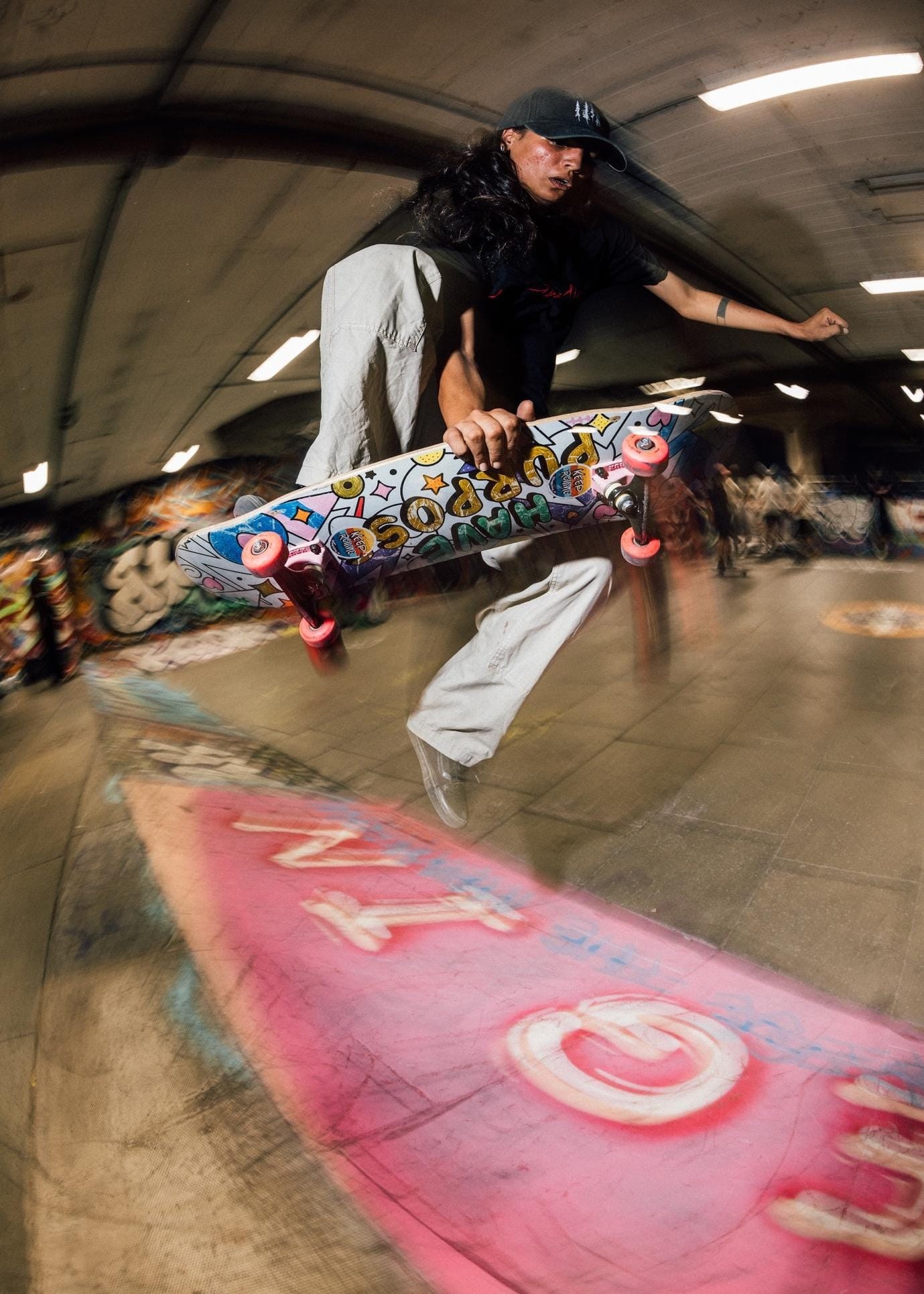
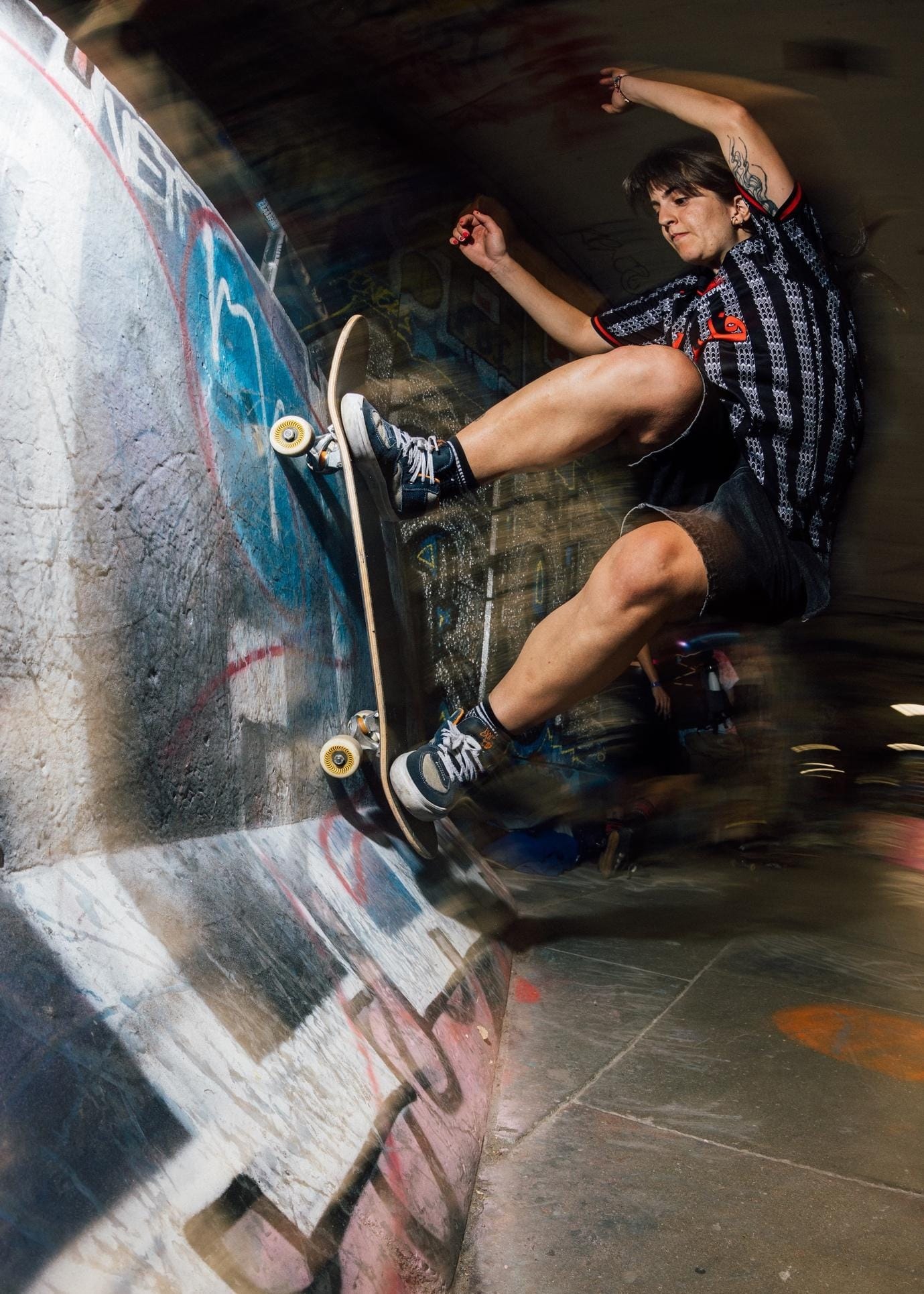
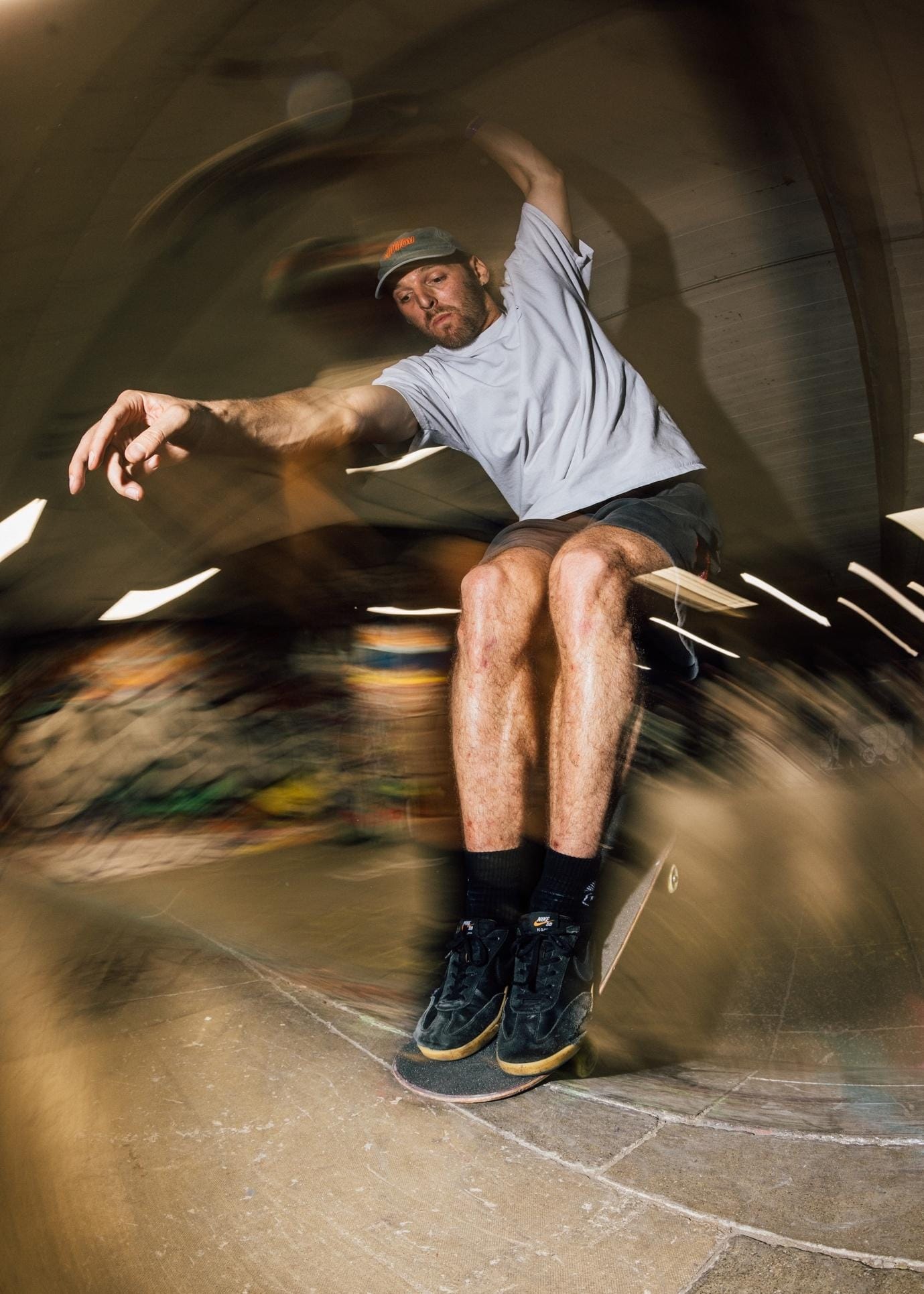
Figure 1: Houda Ait Lahcen, boneless | Figure 2: Denia Kopita, wallride fakie | Figure 3: Nytaï Sam Aidlin, hang ten nose stall | Photos: Norma Ibarra, Southbank, 24 May 2026.
The magic of skateboarding — and of skate spots — is of course highly subjective and intangible. The intersectional positionalities and lived experiences of many of the attendees, which included organizers from gender-inclusive skate initiatives such as Filika (Athens), Space Invaders (Hamburg), U Can Skate (Mexico) and Tifrkhin (Morocco) — to name only a few — will have informed such subjectivities, my own included. This moment did not emerge from nowhere; it was made possible by years of organizing, advocacy, and community-building by these and countless other changemakers, long before that Sunday evening. It was the collective energy of these efforts, summoned together and expressed through the act of skateboarding itself, that created something truly special. Something attested to on social media (Halsell, 2026; U Can Skate, 2026). The sort of moment that will stick in one’s memory not as nostalgia but as motivation, fuel for further change.
As someone with a preexisting aversion to Southbank, this single skate session not only repaired my relationship to the skate spot, but — to a certain degree — also with skateboarding itself. Being a traditional skateboarder, I experienced and understood the traditional forms of skate magic, yet through working on gender-inclusive social skate projects (Meadley, 2025) I increasingly grew disillusioned with traditional skateboarding and its legacy of exclusion. For me, the magic of traditional skateboarding had died; only finding new forms of radicality within non-traditional skateboarding. Yet following our Sunday evening session at Southbank, the binary of traditional and non-traditional felt no longer adequate. Something new was being prefigured; something we might conceptualize as new-traditional skateboarding.
The special ingredient to this understanding — and to our skate session — was the presence of skate photographer Norma Ibarra. As one of very few female photographers to establish themselves within skate media (Golding, 2024), and one of a small cohort of female photographers in professional sports photography more broadly (Bailey, 2024), Ibarra carries a similar folkloric reverence only previously afforded to select male skate photographers within traditional skate media. The lens Ibarra both literally and figuratively brings to traditional skateboarding contexts plays a major role in the ongoing strategic visibility of non-traditional skateboarders; but reciprocally, it brings the mechanisms of value creation within traditional skateboarding into non-traditional skateboarding spaces. It is in this convergence of the old magic and the new that an even greater form of transmutation takes place.
If traditional street skateboarding functioned as a subversion of the hegemonic logics of the neoliberal city, and non-traditional skateboarding now operates as a subversion of the internal hegemonies of skate culture itself, then what was taking place at Southbank—one of the most symbolically laden of skate spots — was not merely subversive, but, more significantly, reparative. In this moment, the Undercroft constituted a therapeutic landscape, a “healthy space” (Bell et al., 2018) in which some of the weight of historic exclusions was, however partially, being relinquished. It was the layering of contradictions — permissive skate space in a traditional spot, traditional rituals with non-traditional conviviality, non-traditional leadership with traditional allyship, captured through a traditional lens held by a non-traditional hand — that made such an enchantment possible. In consciously avoiding the self-romanticization one might equally critique traditional skate media for, it is necessary to acknowledge that such a moment was also only achievable through the financial and organizational support of the Social Skate Summit, alongside the ongoing defiance labour (Willing & Pappalardo, 2023) and safety work (Vera-Gray & Kelly, 2020) of both the organizers and non-traditional attendees. Such moments are rare, but through situated enactment they conjure imaginaries for future versions of skateboarding — ones built on an entirely new tradition: a tradition of inclusion.
New-traditional skateboarding is not, however, a reconciliation that neutralizes skateboarding’s critical edge. It is instead a rapprochement; one that expands what skateboarding’s radicality can mean, and crucially, who gets to embody it. What was taking place that Sunday evening at Southbank was not just a reclamation of space, but of the very mechanisms through which skateboarding accrues meaning. New-traditional skateboarding takes the most potent elements of what skateboarding has always done — claimed space, created community, made something from nothing — and turns that same logic on the culture itself. Southbank has always been many things to many people. What it became that Sunday evening, however briefly, was something it had never quite managed before: a space that belonged to everyone.
Footnote
1. The Social Skate Summit took place 23–25 May 2026 at UCL East Campus, London, UK. Co-organised by Keep Rolling Project, City Mill Skate and The Goodpush Alliance, with funding and support from University College London (UCL), Skateistan, ISCP (International Skateboard Certification Program), CHPO, SkateboardGB and BAYSIXTY6.
Author
Sources
Bailey, H. (2024, August 30). We Mind the Gap. Glorious Sport. https://glorioussport.com/articles/hannah-bailey-olympics-gender-balance-sports-photographers/
Barrow, T. (2018, September). Vibeology. Transworld Skateboarding, (394). https://www.skateboarding.com/archives/vibeology
Bell, S. L., Foley, R., Houghton, F., Maddrell, A., & Williams, A. M. (2018). From therapeutic landscapes to healthy spaces, places and practices: A scoping review. Social Science & Medicine, 196, 123–130. https://doi.org/10.1016/j.socscimed.2017.11.035
Benjamin, W. (2008). The Work of Art in the Age of Mechanical Reproduction (J. A. Underwood, Trans.). Penguin. (Original work published 1935)
Borden, I. (2001). Skateboarding, space and the city: Architecture and the body. Berg.
Borden, I. (2015). Southbank skateboarding, London, and urban culture: The Undercroft, Hungerford Bridge, and House of Vans. In K.-J. Lombard (Ed.), Skateboarding: Subcultures, Sites and Shifts (pp. 91–107). Routledge. https://doi.org/10.4324/9781315737577
Borden, I. (2019). Skateboarding and the city: A complete history. Bloomsbury Visual Arts. https://doi.org/10.5040/9781474208420
Delardi, C. (2021). Pushing boarders, creating alternative futures: Resistance and radical inclusion in the production of Non-Traditional Skateboarding culture [MA Thesis]. Gallatin School of Independent Study, New York University.
Dupont, T. (2014). From Core to Consumer: The Informal Hierarchy of the Skateboard Scene. Journal of Contemporary Ethnography, 43(5), 556–581. https://doi.org/10.1177/0891241613513033
Golding, F. (2024). Norma Ibarra: Portfolio. Closer, 3.1(9), 54–58.
Halsell, S. [@susiefrogod]. (2026, June 5). Escalator of Legends 🪷🛹🙈 on our way to the iconic South Bank for one of the most memorable skate sessions in the history of the social skate scene/sector/niche? What do we even call it other than pure incredible-ness 🤘🏽💚😝. [Video]. Instagram. https://www.instagram.com/p/DZOCogSBIFv/
Lobe, S. (2026, April 16). Eating concrete with London Skate Mums. Huck. https://www.huckmag.com/article/eating-concrete-london-skate-mums-southbank-50
Long Live Southbank. (2020). Long Live Southbank. Urban Pamphleteer: Skateboardings, (8), 50. https://doi.org/10.13140/RG.2.2.21425.66406
Madgin, R., Webb, D., Ruiz, P., & Snelson, T. (2018). Resisting relocation and reconceptualising authenticity: The experiential and emotional values of the Southbank Undercroft, London, UK. International Journal of Heritage Studies, 24(6), 585–598. https://doi.org/10.1080/13527258.2017.1399283
Meadley, H. (2025). The Art of Skating Institutions: Incidental Positionality as an Artistic Strategy in Reappropriating Civic Space [Thesis, Leeds Beckett University]. https://doi.org/10.25448/lbu.29608991.v2
Mould, O. (2014, February 3). Intervention - ‘The Southbank and the Skaters: The Cultural Politics of Subversion’. Antipode Online. https://antipodeonline.org/2014/02/03/intervention-the-southbank-and-the-skaters-the-cultural-politics-of-subversion/
nikeskateboarding. (2022, May 19). Nike SB | Casper Brooker | Cathedral [Video recording]. https://www.youtube.com/watch?v=O851jR0lh5c
O’Connor, P. (2018). Handrails, steps and curbs: Sacred places and secular pilgrimage in skateboarding. Sport in Society, 21(11), 1651–1668. https://doi.org/10.1080/17430437.2017.1390567
O’Connor, P., Evers, C., Glenney, B., & Willing, I. (2023). Skateboarding in the Anthropocene: Grey spaces of polluted leisure. Leisure Studies, 42(6), 897–907. https://doi.org/10.1080/02614367.2022.2153906
Porter, N. (2025). Girl gangs, zines, and powerslides: A history of badass women skateboarders. ECW Press.
Roussel, A., & Sherlock, R. (Directors). (2026). Southbank – Beyond The Stereotype [Video recording].
Ruiz, P., Snelson, T., Madgin, R., & Webb, D. (2020). ‘Look at What We Made’: Communicating subcultural value on London’s Southbank. Cultural Studies, 34(3), 392–417. https://doi.org/10.1080/09502386.2019.1621916
Sayers, E. (2023). Skateboarding, Time and Ethics: An Auto Ethnographic Adventure of Motherhood and Risk. Sport, Ethics and Philosophy, 17(3), 306–326. https://doi.org/10.1080/17511321.2023.2180533
Sedgwick, E. K. (2003). Paranoid reading and reparative reading, or, you’re so paranoid, you probably think this essay is about you. In Touching feeling: Affect, pedagogy, performativity (pp. 123–151). Duke University Press.
Stanford, E. (2026, May 30). 50 Years of Skateboarding at London’s Southbank Undercroft. The New York Times. https://www.nytimes.com/2026/05/30/arts/london-southbank-undercroft-skate-park.html
Stephenson, M. (Director). (2026, May 24). Half a century of skateboarding celebrated in London’s Southbank [Broadcast]. In Channel 4 News. https://www.channel4.com/news/half-a-century-of-skateboarding-celebrated-in-londons-southbank
U Can Skate [@ucanskate]. (2026, June 5). The moments that we shared in the last skate sesh of the Social Skate Summit, in Southbank, reminded us about the magic of the Skateboarding! 🔥🫀🤜🏽✨🤛🏽 [Video]. Instagram. https://www.instagram.com/p/DZOCogSBIFv/
Vera-Gray, F., & Kelly, L. (2020). Contested gendered space: Public sexual harassment and women’s safety work. International Journal of Comparative and Applied Criminal Justice, 44(4), 265–275. https://doi.org/10.1080/01924036.2020.1732435
Warin, R. (2018). Long Live Southbank: Skateboarding, citizenship and the city. The Journal of Public Space, 3(3), 149–158. https://doi.org/10.32891/jps.v3i3.1138
Willing, I., & Pappalardo, A. (2023). Skateboarding, Power and Change. Palgrave Macmillan. https://doi.org/10.1007/978-981-99-1234-6